
Synopsis:
German vehicles demand disciplined maintenance to avoid major mechanical failures. All German Auto explains how factory schedules, early diagnostics, cooling system care, electrical testing, and brand-specific service reduce long-term costs.
Key Takeaways:
- Follow manufacturer service intervals strictly
- Address warning lights immediately
- Inspect cooling and suspension systems regularly
- Test batteries and charging systems annually
- Choose trained German brand technicians

Preventing major repair costs on your German vehicle requires three key practices: adhering to manufacturer maintenance schedules, responding to early warning indicators, and selecting a shop with brand-specific expertise. The sophisticated engineering in BMW, Mercedes-Benz, Audi, Porsche, and Volkswagen models delivers outstanding performance, but maintaining that performance depends on proactive service rather than waiting for breakdowns.
At All German Auto in Escondido, we work exclusively with German-manufactured vehicles. Our experience in German repair shows a clear pattern: owners who maintain regular service schedules avoid the costly mechanical failures that affect vehicles with inconsistent maintenance histories. Your vehicle’s precision engineering deserves equally precise care.
We explain which maintenance practices protect your investment, identify warning signs that require immediate attention, and demonstrate how scheduled service prevents the expensive repairs that result from deferred maintenance.
Why German Vehicles Require a Different Maintenance Approach
Precision Engineering and Tighter Tolerances
German manufacturers build vehicles with components machined to extremely tight specifications. Engine components in BMW, Mercedes-Benz, Audi, and Porsche models operate with clearances measured in thousandths of an inch. These tight tolerances deliver exceptional performance but require consistent lubrication, proper fluid chemistry, and clean oil to function as designed.
Preventive maintenance addresses wear before it causes damage. This approach saves money because catching problems early prevents one failing component from damaging related systems. A worn timing belt that gets replaced during scheduled service costs less than the engine damage that occurs when that belt breaks during operation.
Delayed Service Creates Cascading Problems
Consider what happens when a water pump begins failing. The pump itself may only need replacement, but if operation continues until complete failure occurs, the resulting overheating can warp aluminum cylinder heads and damage head gaskets. The initial pump issue becomes an engine rebuild requiring extensive mechanical work.
Our service records at All German Auto demonstrate this pattern repeatedly. Vehicles brought in for factory-scheduled maintenance at manufacturer-specified intervals rarely experience unexpected component failures. Vehicles with irregular service histories show significantly higher rates of major system failures requiring extensive German mechanical repair.
As the average vehicle age increases, maintenance becomes increasingly critical. Vehicles now stay on the road longer than ever, making consistent mechanical service at a qualified German auto repair shop the difference between reliable transportation and frequent repair bills.
Follow Factory-Scheduled Maintenance Without Skipping Intervals
Vehicle manufacturers establish service intervals based on extensive testing of how components degrade under normal operating conditions. These schedules account for oil breakdown rates, belt deterioration patterns, fluid contamination, and brake wear characteristics specific to each model.
Mercedes-Benz Maintenance Requirements
Mercedes-Benz uses a structured approach with Service A and Service B designations. Service A occurs at 10,000 miles or after one year of ownership, whichever comes first. This service includes engine oil and filter replacement, fluid level verification, tire pressure inspection, and brake component examination.
Service B follows at 20,000 miles or two years and includes everything in Service A plus cabin air filter replacement and additional system checks. After the initial services, the pattern alternates every 10,000 miles: Service A at 30,000 and 50,000 miles, Service B at 40,000 and 60,000 miles.
BMW, Audi, and Porsche Service Protocols
BMW employs Inspection I and Inspection II services at specific mileage intervals. These comprehensive checks address fluid services, brake inspections, and system diagnostics tailored to BMW engineering specifications. Audi recommends service appointments every 10,000 miles with specific procedures outlined for each interval. Porsche service requirements vary by model, but maintain strict adherence to factory specifications.
Critical Maintenance Components
Several key systems require regular attention to prevent expensive failures:
- Engine oil and filter replacement: Maintains proper lubrication and removes contaminants that cause internal engine wear
- Cooling system service: Prevents overheating that warps cylinder heads and damages gaskets
- Transmission fluid service: Preserves smooth gear changes and prevents internal transmission component deterioration
- Brake system inspection and service: Identifies pad wear before metal-to-metal contact damages rotors
- Suspension component inspection: Detects bushing wear and ball joint deterioration before alignment problems develop
We perform all factory-specified maintenance following exact manufacturer procedures. The difference in long-term reliability between maintained and neglected vehicles is substantial and measurable in our service records.
Do Not Ignore Dashboard Warning Lights
While following factory maintenance schedules prevents most problems, issues can develop between service intervals. Your vehicle’s warning systems provide early notification when components begin showing signs of wear or failure. Modern German vehicles employ sophisticated monitoring systems that continuously evaluate hundreds of parameters throughout your vehicle. BMW, Mercedes-Benz, Audi, Porsche, and Volkswagen engineer these warning systems to alert you before minor issues become major failures. When a dashboard warning light illuminates, your vehicle’s onboard diagnostics have detected a condition requiring immediate attention.
Why Immediate Response Matters for German Vehicles
The sophisticated engineering that delivers superior performance also means component systems interact in complex ways. A problem in one system often affects multiple related systems. Consider a BMW displaying a coolant level warning. This might indicate a simple need to add coolant, or it could signal a developing leak. Continuing to drive without diagnosis allows a minor leak to worsen, eventually causing overheating that warps aluminum cylinder heads, blows head gaskets, and potentially cracks the engine block. What began as a simple warning requiring a quick fix becomes an engine rebuild costing thousands of dollars.
Critical Warning Lights Requiring Professional Diagnosis
Check Engine Light: Indicates emissions system problems, sensor failures, or engine management issues. Early diagnosis identifies specific failures before they damage other components, such as oxygen sensor problems that can destroy expensive catalytic converters if ignored.
- ABS/Brake Warning Light: Signals problems with anti-lock brakes or brake system pressure. German vehicles integrate ABS with stability control and traction management. A failure in one system compromises the entire safety architecture.
- Battery/Alternator Warning Light: Indicates charging system failure. German vehicles contain extensive electronics requiring stable voltage. Charging system failures cause erratic behavior in engine management, transmission controls, and safety systems.
- Oil Pressure Warning Light: Signals dangerously low oil pressure that can destroy engine bearings within minutes. This warning demands immediate shutdown and professional diagnosis.
- Coolant Temperature Warning: Indicates engine overheating that causes immediate severe damage to German engines’ aluminum components.
Why Specialized Diagnostic Equipment Matters
German manufacturers design their vehicles with proprietary diagnostic protocols that require specialized equipment to access properly. Unlike generic code readers available at auto parts stores, professional diagnostic systems can access the detailed fault information, live sensor data, and system-specific parameters stored within your vehicle’s control modules. This deeper level of access allows technicians to identify the exact cause of warning lights rather than simply reading basic trouble codes.
At All German Auto, we invest in state-of-the-art diagnostic equipment specifically designed for German vehicles. Our diagnostic capabilities allow our technicians to perform comprehensive system analysis, read manufacturer-level fault codes, monitor real-time sensor data, and verify repairs accurately. This specialized equipment, combined with our technicians’ brand-specific training and over 30 years of German vehicle experience, ensures problems get diagnosed correctly the first time. When warning lights appear, prompt diagnosis at our Escondido facility identifies problems early, preventing the expensive cascading failures that result from continued operation with active warnings.
Understanding the specific systems most critical to German vehicle reliability helps you recognize potential issues even before warning lights appear. Three systems in particular–cooling, suspension, and electrical–require proactive attention to prevent the costly failures that commonly affect German vehicles with deferred maintenance.
Cooling System Maintenance Prevents Engine Damage
German engines produce substantial heat during operation. Your cooling system manages this thermal load through coordinated operation of multiple components. Water pumps circulate coolant through the engine block and cylinder heads. Thermostats regulate coolant flow to maintain optimal operating temperature. Radiators transfer heat to the outside air. Expansion tanks maintain system pressure and accommodate coolant volume changes.
Component Deterioration Patterns
Many cooling system components incorporate plastic housings and rubber seals that degrade over time through exposure to heat and coolant chemistry. BMW water pump impellers develop cracks. Mercedes-Benz thermostats stick in position. Audi expansion tanks crack along seams. VW radiator tanks are separate from aluminum cores.
These failures develop gradually rather than suddenly. Regular inspection during German mechanical repair service identifies components showing early deterioration before complete failure occurs.
Consequences of Cooling System Failure
Engine overheating is one of the top causes of roadside breakdowns. Overheating doesn’t merely leave you stranded. Extreme temperatures warp aluminum cylinder heads, blow head gaskets, and can crack engine blocks. These repairs require extensive work and could be prevented by replacing wearing components identified during inspection.
Local Climate Considerations
Escondido experiences warm summers that increase cooling system workload. Higher ambient temperatures mean your cooling system operates closer to thermal limits during the summer months. Spring cooling system service at our German auto repair shop prepares your vehicle for summer heat by identifying and replacing components showing wear.
Our technicians at All German Auto inspect all cooling system components during regular maintenance intervals, checking for leaks, testing coolant condition, and examining hoses and connections for deterioration.
Suspension and Steering Issues Develop Gradually
Suspension components wear slowly over thousands of miles. Control arm bushings compress and tear. Ball joints develop internal play. Shock absorbers and struts lose damping effectiveness. These changes occur gradually enough that you unconsciously adapt your driving to compensate, never noticing the degradation until it becomes severe.
Secondary Damage From Worn Suspension
Suspension wear affects more than ride quality. Deteriorated control arm bushings allow wheel position to shift, changing alignment angles and causing tires to wear unevenly. What begins as a minor bushing issue becomes premature tire replacement.
Worn struts and shocks increase braking distances because the suspension cannot control wheel contact with the road surface effectively. Failed ball joints create dangerous conditions where steering precision is compromised.
Proactive Suspension Service
Regular suspension inspection during scheduled maintenance at our German auto repair shop identifies wear patterns early. Our technicians at All German Auto check bushing condition, test ball joint play, and evaluate shock absorber performance. Replacing components showing wear prevents secondary problems that multiply repair costs.
Electrical System Maintenance in Modern German Cars
German vehicles contain extensive electronic systems controlling engine management, transmission operation, climate control, safety systems, and infotainment functions. All these systems depend on stable electrical power from your battery and charging system.
Control modules are specialized computers requiring consistent voltage to function reliably. Batteries weakening with age cause erratic module behavior. Alternators beginning to fail create voltage fluctuations that confuse sensitive electronics.
How Electrical Problems Multiply
A battery nearing the end of its service life creates symptoms throughout your vehicle. Electronic modules may reset unexpectedly. Systems fail to initialize properly on startup. Warning lights illuminate without corresponding mechanical problems. Replacing the battery resolves all these issues immediately.
Alternator problems affect multiple systems simultaneously because voltage irregularities impact every electronic component in the vehicle. What appears to be several unrelated failures often traces back to one electrical source problem.
Preventive Battery Testing
We test battery condition and charging system performance during regular maintenance appointments at All German Auto. This quick check prevents electrical issues that lead to extensive diagnostic work. Battery testing takes minutes but avoids hours of troubleshooting later when electrical problems appear.
Driving Habits in Escondido That Impact Mechanical Wear
Local driving patterns in Escondido and the surrounding North County areas create specific wear characteristics. Stop-and-go traffic patterns on Interstate 15 place more stress on transmissions and cooling systems than steady highway driving. Short trips around town prevent engines from reaching full operating temperature, allowing moisture and fuel contamination to accumulate in engine oil.
Summer heat exposure affects rubber hoses, seals, and plastic cooling system components. Elevated temperatures accelerate the deterioration of these materials. Regular service intervals at our German auto repair shop account for these environmental factors when evaluating component condition.
Mountain Driving Impact
Trips to Julian, Palomar Mountain, or other elevation changes in the region create different mechanical stress patterns. Extended uphill grades test cooling system capacity and brake performance. Long descents load braking systems continuously. These conditions don’t harm properly maintained vehicles, but accelerate wear on components compromised by deferred service.
Choosing the Right German Auto Repair Shop in Escondido
Importance of Brand-Specific Training
Accurate diagnosis requires diagnostic equipment programmed specifically for your vehicle’s manufacturer. Generic scan tools read standardized trouble codes but cannot access detailed information in brand-specific systems. BMW diagnostic software differs fundamentally from Mercedes-Benz protocols. Audi, Porsche, and VW each employ unique system architectures.
Our technicians at All German Auto complete ongoing training specific to the German brands we service. This training covers new model technology, updated service procedures, and common failure patterns unique to each manufacturer. We maintain diagnostic equipment matching dealership capabilities for German repair.
Parts Quality Matters
We use OEM (Original Equipment Manufacturer) parts or premium equivalents meeting factory specifications. Parts quality varies dramatically in the aftermarket. Premium components perform identically to OEM parts. Budget alternatives often fail prematurely, requiring the same repair twice.
Why General Shops Miss Critical Details
General automotive repair facilities lack brand-specific diagnostic tools and training. Their technicians read generic trouble codes that provide limited information for accurate diagnosis. This often results in parts replacement based on probability rather than confirmed fault identification.
German vehicle systems integrate differently from domestic or Japanese models. A technician experienced with Ford or Toyota hasn’t necessarily encountered the fuel injection architecture, cooling system controls, or transmission management strategies used in German vehicles.
Convenient Escondido Location
Location matters for regular maintenance. Bringing your vehicle to our facility at 1327 Simpson Way in Escondido means working with technicians specializing exclusively in German mechanical repair. We understand specific requirements that prevent expensive failures in Mercedes-Benz, BMW, Audi, Porsche, VW, Mini, and Sprinter vehicles. This is something our customers experience, as evidenced by this Google review: “I’ve used All German to maintain my BMWs, Audis, and VWs for nearly 20 years and I wouldn’t take them anywhere else. Dan, my advisor, is great and keeps me informed and updated on the car’s progress and I’ve never had a problem. I highly recommend this shop.”
Preventive Maintenance Checklist for German Vehicle Owners
Follow these practices to minimize long-term repair costs:
- Maintain strict adherence to factory service schedules.
- Respond immediately to dashboard warning lights. Early diagnosis prevents minor sensor issues from becoming major system failures.
- Include cooling system inspection in every service interval. Replace water pumps, thermostats, and deteriorating hoses before failure occurs.
- Test battery condition annually after three years of service. Replace batteries showing weakness before voltage problems affect electronic modules.
- Schedule regular suspension system inspection. Replace bushings, ball joints, and struts showing wear before alignment and tire damage occur.
- Choose All German Auto for German auto repair with brand-specific expertise. Accurate diagnosis prevents unnecessary parts replacement and repeated repairs.
These maintenance practices cost substantially less than the repairs resulting from deferred service. Regular appointments at manufacturer-specified intervals represent your lowest total cost of ownership.
Protect Your Investment Through Preventive Service
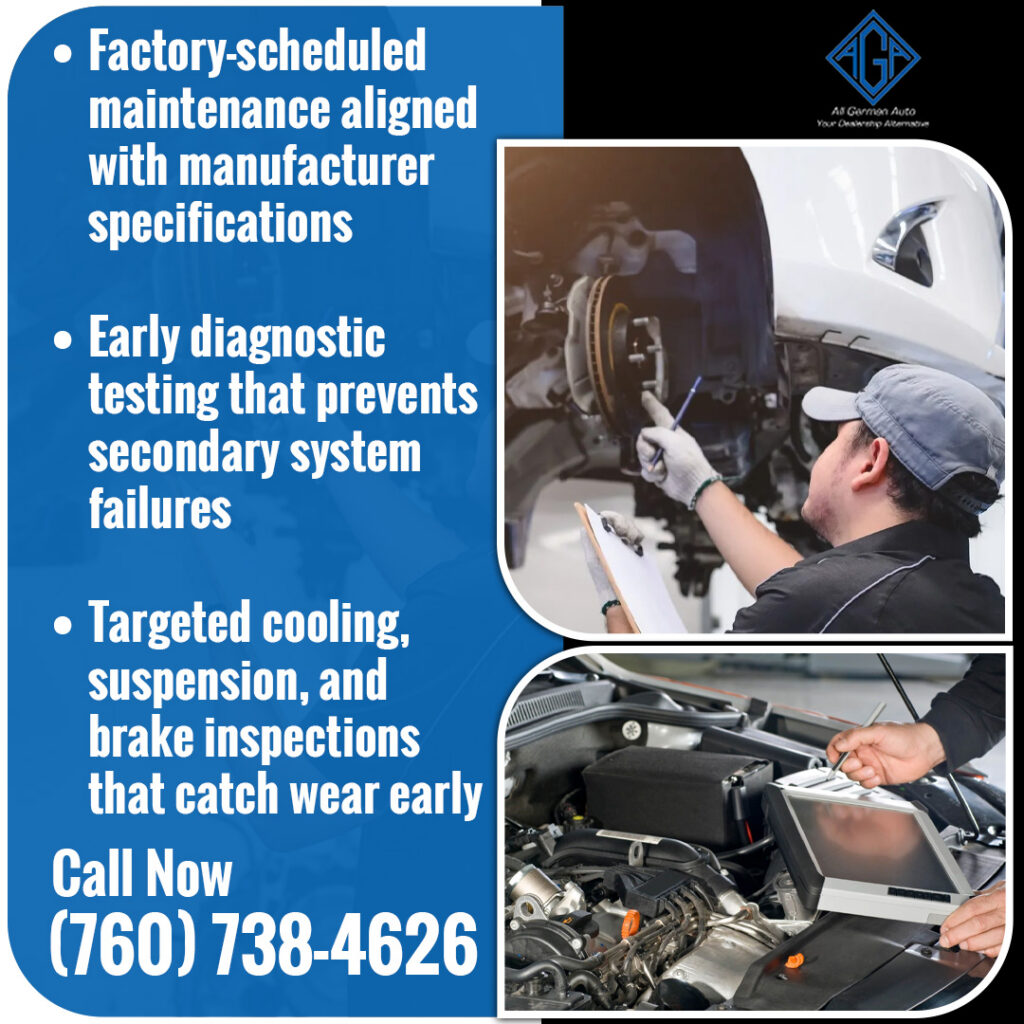
German engineering delivers exceptional performance and driving enjoyment when maintained according to manufacturer specifications. That performance depends on following service schedules, addressing early warning indicators, and selecting service providers with appropriate expertise and equipment.
Daily experience at All German Auto demonstrates the relationship between maintenance consistency and long-term reliability. Vehicles serviced regularly at proper intervals avoid the major mechanical failures affecting those with irregular maintenance histories. Your German vehicle represents a significant financial investment deserving protection through preventive care.
Schedule your next maintenance appointment before minor wear becomes an expensive failure. Our facility provides exclusive German mechanical repair in Escondido with manufacturer-trained technicians, factory-level diagnostic equipment, and OEM parts. We service all German brands, including Mercedes-Benz, BMW, Mini, Porsche, Audi, VW, and Sprinter vehicles.
Contact All German Auto at (760) 738-4626 or [email protected] to schedule service or discuss your vehicle’s specific maintenance requirements. Visit us at 1327 Simpson Way in Escondido, California.

