

Synopsis:
Early engine diagnostics prevent minor faults from turning into major repairs in German vehicles, where complex sensor systems track performance in real time.
- Detect hidden issues before symptoms appear
- Use brand-specific tools for accurate fault identification
- Prevent costly damage like catalytic converter failure
- Maintain engine performance and fuel efficiency
- Support long-term reliability through routine diagnostics

Your German vehicle runs on precision. From the moment you start the engine, a network of sensors tracks fuel delivery, coolant temperature, exhaust output, and ignition performance. When a reading drifts outside its normal range, the system logs a fault code, and a warning light may or may not follow right away.
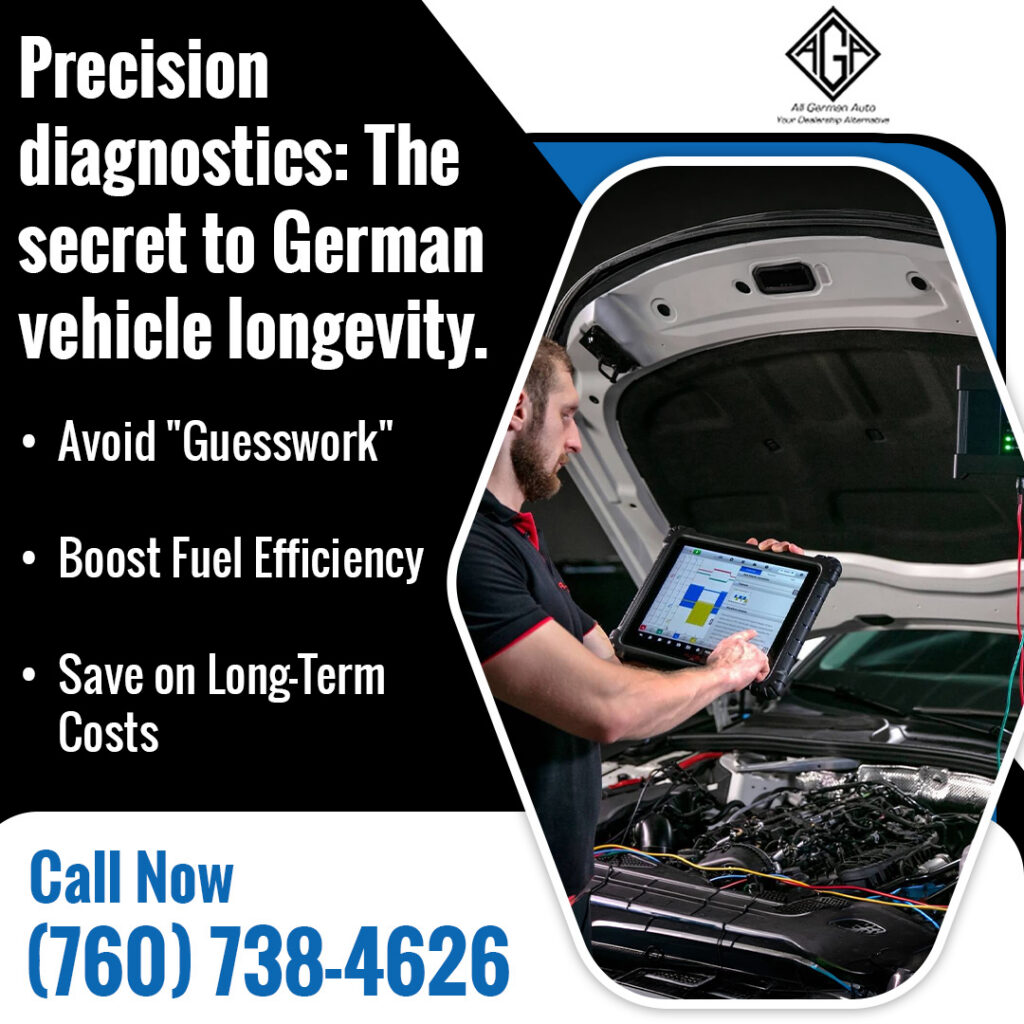
That gap is where diagnostics matter most. Catching a fault early stops a small problem from becoming a costly repair. For German repair to deliver real value, diagnostics have to come first. At All German Auto, our ASE-certified technicians use brand-specific diagnostic equipment to read what your vehicle is already recording, often well before you notice anything wrong.
What Are Engine Diagnostics in a German Vehicle?
Engine diagnostics means reading data from your vehicle’s onboard computer systems, interpreting it, and pinpointing where a fault originates. A thorough scan reviews multiple systems at once, giving a trained technician an accurate view of how the engine is performing.
How the Onboard Diagnostic System Works
Every German vehicle sold in the U.S. since 1996 uses an OBD-II system. Sensors continuously monitor:
- Fuel injection timing and delivery
- Ignition system performance
- Exhaust gas composition and emissions
- Coolant and intake air temperature
- Engine load and airflow volume
When a reading falls outside the acceptable range, the system stores a Diagnostic Trouble Code (DTC). The code flags which system is affected, but not always which specific component has failed.
According to automotive sensor research published by ScienceDirect, a current luxury vehicle contains approximately 100 sensors of around 70 different types. In a BMW 5 Series, Mercedes-Benz E-Class, or Porsche Cayenne, that count runs even higher.
Why German Vehicles Need Brand-Specific Diagnostic Equipment
Generic OBD-II scanners read only universal fault codes. They do not reach the proprietary data stored in the individual control modules that German manufacturers use. Every brand we service, BMW, Mercedes-Benz, Mini, Porsche, Audi, VW, and Sprinter, runs its own electronic architecture with fault data that standard tools cannot access. A scan on a BMW with power loss might return a broad misfire code. Brand-compatible equipment identifies the actual component responsible, eliminating guesswork and unnecessary parts replacement.
Why Early Diagnostics Matter for German Auto Repair
Identifying a fault early almost always costs less than repairing the damage that results from ignoring it. In German vehicles, tightly integrated systems mean one fault can quietly damage another.
A failing oxygen sensor may not cause obvious symptoms at first. But when it feeds bad data to the engine computer, the engine runs fuel-rich, gradually damaging the catalytic converter. That becomes a far more expensive repair than addressing the sensor when the code first appeared.
The 2025 CarMD Vehicle Health Index, based on more than 31 million OBD-II failures recorded in 2024, found that catalytic converter replacement averaged $1,348 and was the most common check-engine repair that year. The average across all check-engine faults was $415.31. In most catalytic converter cases, the failure was traced to an earlier sensor fault that went unaddressed.
Beyond repair costs, consistent diagnostics keep your vehicle running to its calibration standards, and a documented service history supports stronger resale value when it comes time to sell. This is why proper German auto repair always begins with accurate diagnostic testing.
What Ignoring a Warning Can Cost You
| Issue Detected Early | Potential Outcome if Ignored |
| Faulty oxygen sensor | Catalytic converter damage (~$1,348 avg. repair) |
| Cooling system fault | Engine overheating, potential engine failure |
| Weak ignition coil or spark plug | Engine damage, failed emissions test |
| Fuel injector fault | Carbon deposits, poor combustion efficiency |
| Mass airflow sensor drift | Higher fuel consumption, rough idle |
Source: 2025 CarMD Vehicle Health Index, calendar year 2024 data
Common Problems a Diagnostic Scan Can Catch
A scan covers far more than the check engine light. These are the fault categories we see most often in German vehicles.
Check Engine Light Triggers
Common causes include:
- Oxygen sensor failure: distorts the air-fuel ratio and affects emissions output
- Catalytic converter inefficiency: often downstream of an unaddressed upstream fault
- Engine misfires: linked to ignition coils, spark plugs, or fuel delivery issues
Other Frequent Fault Types
Fuel system: Partially restricted injectors deliver uneven fuel spray, causing rough running and carbon buildup. These faults often appear in stored codes before any driving symptom shows.
Cooling system: German vehicles use electronically managed thermostats that generate fault codes before the temperature gauge moves. Finding this early prevents overheating damage, one of the costliest engine repairs on any German vehicle.
Ignition wear: Failing spark plugs or ignition coils produce misfires that start as a subtle shudder at idle. Diagnostic scanning identifies the affected cylinder and component, removing the need for trial-and-error parts replacement.
Electrical faults: Dense electrical networks in German vehicles mean one faulty sensor can trigger warnings across multiple systems. Brand-compatible diagnostics trace the fault to its source rather than treating each symptom separately.
Signs It Is Time to Schedule a Diagnostic Check
Bring your vehicle in if you notice any of the following:
- Check engine light: steady or flashing
- Loss of power or sluggish acceleration
- Rough idling or engine shuddering
- Higher fuel consumption without a change in driving habits
- Engine knocking or unusual sounds under the hood
- Visible smoke or unusual odor from the exhaust
- Transmission hesitation or rough gear changes
A flashing check engine light is an urgent signal. It indicates an active misfire that can damage the catalytic converter quickly. Do not continue driving. Have the vehicle checked right away.
How We Handle German Repair Diagnostics
Our process is built on accuracy at every step.
Step 1 Brand-Compatible Computer Scan
We connect advanced, brand-compatible scan tools to your vehicle’s OBD port. Our equipment accesses manufacturer-level data stored across your vehicle’s individual control modules, the layer of fault information standard scanners cannot reach. We read stored fault codes, live sensor data, and freeze-frame readings to build a complete picture of what the engine is doing.
Step 2 Inspection and Component Testing
We cross-reference fault data with a hands-on inspection of the affected systems: electrical connections, fuel components, cooling circuit, and associated parts. Individual sensors and mechanical components are tested against manufacturer specifications. A reading outside its normal range is confirmed before any repair recommendation is made. This level of precision supports accurate German mechanical repair without unnecessary parts replacement. This protects you from paying for parts your vehicle does not need.
Step 3 Clear Repair Recommendations
We explain what the data shows and what we recommend before any work begins. No surprises; you understand and approve the repair first.
Our team’s credentials support every step of this process. Chance Whitaker, our VP of Operations and General Manager, has held Mercedes-Benz Master Technician certification since 1998 and ASE Master Certification A1–A8 since 1994, with over 19 years as a lead technician at Hoehn Mercedes-Benz; the same training level dealership technicians work toward, applied here at a fraction of the cost.
Diagnostic Differences Across German Brands
BMW
BMW’s brand-specific fault coding goes beyond what generic OBD-II tools capture. Our BMW-specific scan tools identify the actual source of a fault rather than a surface-level symptom code.
Mercedes-Benz
Mercedes-Benz models track service intervals through the Flexible Service System (FSS), monitoring individual component wear rather than mileage. Reading and resetting the FSS correctly after service requires compatible equipment. Otherwise, your vehicle will not accurately flag the next interval.
Audi and Volkswagen
Turbocharged TFSI and TSI engines store fault data for boost pressure and injector performance in brand-specific modules. This is what allows us to deliver a precise Audi or VW diagnosis.
Porsche
Porsche engines are built to very tight tolerances. Our Porsche technician, Erick Talamantes, has focused on high-line German vehicles since graduating from UTI in 2018, giving every Porsche direct, focused platform attention.
Mini and Sprinter
Mini and Sprinter vehicles carry brand-specific fault architectures. We apply the same brand-compatible diagnostic approach to every one we service.
How Factory Maintenance and Diagnostics Work Together
Factory-scheduled maintenance is the most consistent way to get ahead of engine faults. During every service visit, we inspect:
- Brakes: pad wear, rotor condition, and brake fluid health
- Electrical systems: battery, charging output, and lighting
- Cooling system: coolant level, hose condition, and thermostat function
- Fuel injection: filter condition and injector health
- Timing belts: wear and replacement intervals
- Suspension and alignment: steering and handling wear indicators
- Transmission: fluid condition and shift quality
Many faults become visible during a physical inspection before the vehicle stores a fault code. Catching these early reduces the likelihood of major German repair later. Pairing a hands-on inspection with a diagnostic scan gives a more accurate picture than either approach alone.
Why Choosing the Right German Auto Repair Shop Matters
Interpreting a fault code correctly on a German platform and tracing it to the root cause requires brand-specific training, the right equipment, and daily experience on these vehicles. A shop without that background may replace parts based on a surface code, miss the actual fault, and return the vehicle with the same problem unresolved.
Dedicated German auto repair shops like ours service only Audi, BMW, Mercedes-Benz, Mini, Porsche, Sprinter, and VW. That focused experience is what makes German mechanical repair accurate here and what protects your investment over time.
Frequently Asked Questions
What does a check engine light mean on a German car?
It means the onboard diagnostic system has logged a fault in one or more monitored systems. The cause ranges from a loose fuel cap to an active engine misfire. Only a scan with brand-compatible equipment identifies the exact fault.
Can I keep driving with a warning light on?
A steady light: schedule a visit within a few days. A flashing light: stop driving immediately. It signals an active misfire that can damage the catalytic converter fast.
How often should I have diagnostics done?
At every factory-scheduled maintenance interval, typically annually or every 10,000 miles. Any warning light or performance change warrants a check before the next scheduled service.
Do I need a German auto repair shop, or will any shop do?
Brand-compatible equipment and brand-trained technicians make a measurable difference in German vehicles. Generic tools provide only partial data, and a shop without German vehicle experience risks misdiagnosing the fault entirely.
Protect Your Engine; Act on Warnings Early
The most avoidable repairs we see started as a stored code that was left unaddressed. Responding to a warning early costs far less than repairing the damage that builds when you do not.
If your check engine light is on, your performance has changed, or you are due for factory maintenance, bring your vehicle to All German Auto in Escondido, your German auto repair resource for San Marcos, Vista, Valley Center, Rancho Santa Fe, and nearby communities. Call us at (760) 738-4626 or email us at [email protected].

